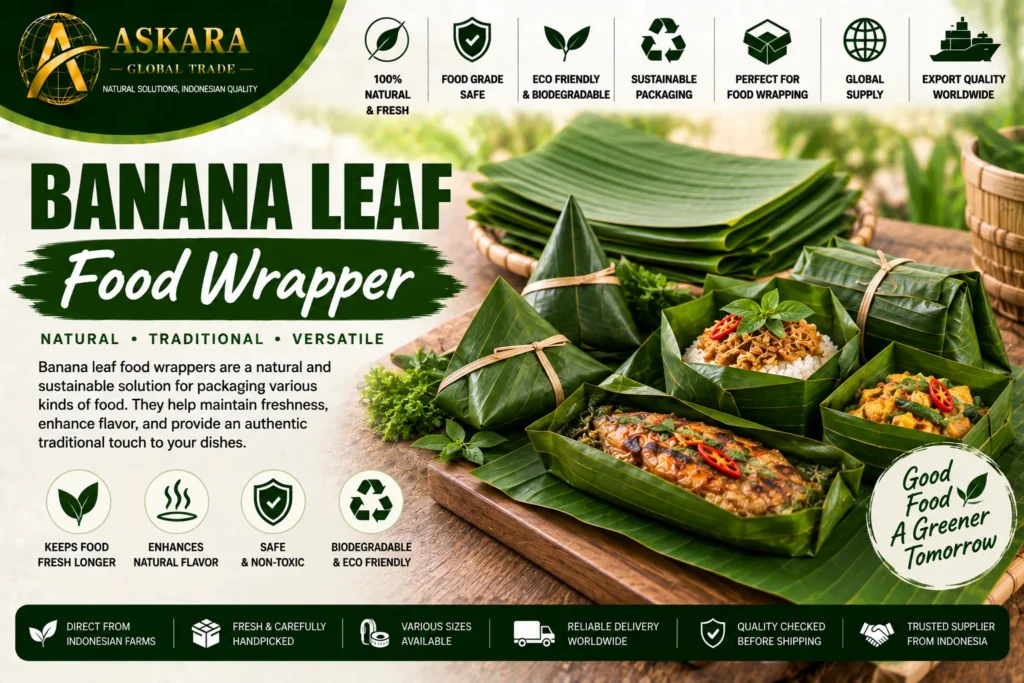
Banana Leaf Food Wrapper
A banana leaf food wrapper can turn a simple meal into something that feels more natural, traditional, and distinctive. Across many Asian cuisines, banana leaves have long been used to wrap, protect, cook, and present different types of food.
Fresh leaves are particularly useful when flexibility and appearance matter. Once properly prepared, they can be folded around food without requiring complicated packaging equipment.
For restaurants, catering businesses, food producers, and specialty food sellers, fresh Klutuk banana leaves can provide another option for food wrapping while maintaining a strong connection to traditional culinary practices.
What Is a Banana Leaf Food Wrapper?
A banana leaf food wrapper is a section of fresh banana leaf used to surround or cover food.
Depending on the dish, the leaf can be folded into a simple parcel, wrapped around a portion of rice or snacks, or used as an outer layer during cooking.
Unlike conventional paper or plastic packaging, banana leaves have a naturally textured surface and recognizable green appearance. This makes them useful not only for containing food but also for creating a distinctive presentation.
Why Banana Leaves Work Well For Wrapping Food
The usefulness of banana leaves comes from a combination of flexibility, surface area, and culinary familiarity.
A properly prepared leaf can be folded around food while remaining visually attractive. It can also separate food from the outside environment during serving or preparation.
Some common reasons for using banana leaves include:
- Natural appearance
- Flexible surface after suitable preparation
- Traditional culinary value
- Useful for individual portions
- Suitable for many types of food
- Attractive presentation
- Easy to cut into different shapes
The exact suitability depends on the food, preparation method, handling process, and intended use.
Foods Commonly Wrapped In Banana Leaves
Banana leaves can be used with many foods, particularly dishes associated with Asian and tropical cuisines.
Rice And Rice-Based Foods
Rice is one of the most familiar foods associated with banana leaf wrapping.
Cooked rice can be placed in the center of a prepared leaf and folded into a compact parcel. Depending on the dish, additional ingredients such as vegetables, meat, fish, or seasonings can be included before folding.
Traditional Snacks
Many traditional snacks have shapes and textures that work naturally with leaf wrapping.
Sticky rice cakes, steamed snacks, cakes, and other prepared foods can be wrapped individually or in small portions.
The green leaf also creates an attractive contrast with colorful desserts.
Grilled Foods
Fish, chicken, seafood, and vegetables can be wrapped in banana leaves before or after cooking, depending on the recipe.
When the leaf is part of the cooking process, the recipe and heat source should determine whether the selected leaf preparation is appropriate.
Steamed Foods
Banana leaves are frequently associated with steaming because they can be folded around individual portions.
The wrapper can help keep ingredients together while contributing a characteristic natural presentation.
How To Prepare Banana Leaves For Wrapping
Fresh leaves should be prepared before they are folded around food.
Begin by selecting clean, intact sections with a suitable size for the intended portion. Inspect the surface and remove sections that are damaged or unsuitable.
Clean the leaves according to an appropriate food-handling procedure. After cleaning, allow excess moisture to drain.
If the leaves are too stiff to fold comfortably, gentle warming can help make them more flexible.
The objective is to soften the leaf without scorching or significantly discoloring it.
Softening Banana Leaves
Fresh banana leaves may become easier to fold after gentle exposure to heat or steam.
The method should depend on the recipe and the condition of the leaf. The leaf should become flexible enough to bend around food without splitting along the surface.
Avoid excessive heating. A leaf that has been overheated may become brittle, darkened, or damaged.
Before wrapping a large batch, test a few pieces first. This can help determine how much preparation is needed for the particular leaves being used.
Cutting Leaves To The Right Size
There is no single cutting size that works for every food.
A small snack may require only a compact square or rectangle, while a larger meal needs a wider section with enough material for overlapping folds.
Fresh Klutuk banana leaves can be supplied in widths of approximately 20–40 cm, with custom sizing available for different requirements.
For commercial operations, standardizing the cutting dimensions for each menu item can reduce preparation time and make finished packages more consistent.
Simple Banana Leaf Folding Methods
The simplest approach is to place the food in the center and fold opposite sides toward the middle.
For a rectangular parcel, the remaining ends can then be folded inward to create a compact package.
For smaller foods, the leaf can be folded into a pocket or simple envelope shape.
The best folding method depends on whether the wrapper is intended primarily for presentation, short-term serving, cooking, or transport.
Using Banana Leaves For Traditional Food
Banana leaf wrapping is particularly suitable for foods where cultural presentation is part of the experience.
Indonesian, Thai, Malaysian, South Asian, and other regional cuisines have culinary traditions involving banana leaves in different forms.
For a restaurant serving traditional dishes, using the leaf can make the presentation feel more connected to the food’s origins rather than simply adding decorative packaging.
Banana Leaf Wrappers For Restaurants
Restaurants can use fresh leaves for individual meals, side dishes, snacks, desserts, and selected takeaway items.
An Indonesian restaurant might wrap traditional rice dishes, while a Thai or Malaysian restaurant may use banana leaves for particular steamed or grilled preparations.
Modern restaurants can also use smaller leaf sections as part of contemporary plating.
The important factor is consistency. Clean preparation, suitable sizing, and repeatable folding techniques can help staff maintain a professional appearance during busy service periods.
Banana Leaves For Catering
Catering operations often prepare large numbers of portions at once, making standardization particularly useful.
Banana leaf wrappers can be prepared for:
- Traditional meal portions
- Rice dishes
- Snacks
- Desserts
- Grilled foods
- Steamed foods
- Cultural events
- Buffet displays
Before adopting leaf wrapping at scale, caterers should determine how many leaves are needed per portion and how much preparation time the wrapping process requires.
Banana Leaf Wrappers For Food Producers
Food manufacturers and small-scale food producers may use banana leaves for selected traditional products.
The wrapper can become part of the product’s identity rather than simply functioning as secondary packaging.
However, commercial food production requires more careful consideration than household preparation. Businesses should evaluate food-contact suitability, sanitation procedures, storage conditions, packaging requirements, and regulations in the destination market.
Natural material does not automatically mean that every application is suitable without proper handling.
Fresh Banana Leaves For Takeaway Food
Takeaway applications require additional planning because the wrapped food may remain packaged for longer than food served immediately.
Consider:
- How long the food will remain wrapped
- Whether the food is hot or cold
- Moisture levels
- The strength of the folded wrapper
- Additional outer packaging
- Transport conditions
- Local food-contact requirements
For some products, the banana leaf may work best as an inner natural wrapper combined with an appropriate secondary package.
Banana Leaves And Sustainable Food Wrapping
Banana leaves are plant-based material, which makes them interesting to businesses exploring alternatives to conventional packaging.
However, sustainability should be evaluated across the complete supply chain rather than based only on the material itself.
Sourcing distance, freshness, handling, packaging, transportation, waste management, and local disposal systems can all influence the environmental performance of a food-wrapping solution.
Therefore, businesses should consider the entire packaging process before making broad sustainability claims.
Fresh Vs Frozen Banana Leaves For Wrapping
Fresh and frozen leaves can behave differently during preparation.
Fresh leaves are often preferred when appearance, natural color, and immediate flexibility are important. Frozen leaves may be useful when businesses need longer-term availability, depending on their supply chain and storage capabilities.
For food presentation, the visual condition of the leaf can be especially important.
For high-volume operations, the better choice depends on menu requirements, storage facilities, delivery conditions, and purchasing schedules.
International Use Of Banana Leaf Wrappers
Banana leaf wrapping has strong cultural relevance in Asian food markets, but its appeal extends beyond Asia.
Restaurants and specialty food businesses in Singapore, Kuala Lumpur, and Bangkok can incorporate banana leaves into traditional and modern menus. In cities such as Sydney, Melbourne, Tokyo, Dubai, London, Toronto, and Los Angeles, Asian restaurants and food businesses can also use leaf wrapping to create a recognizable culinary identity.
This makes banana leaves relevant to both traditional food businesses and international operators looking for distinctive natural presentation.
Ordering Fresh Klutuk Banana Leaves
When sourcing banana leaves for commercial wrapping, buyers should consider the entire preparation process rather than focusing only on price.
Useful purchasing considerations include:
- Leaf freshness
- Available widths
- Custom sizing
- Order quantity
- Packaging method
- Delivery requirements
- Intended food application
- Repeat-order capacity
PT Askara Global Trade supplies fresh Klutuk banana leaves from Indonesia for food wrapping, cooking, serving, and presentation applications.
The leaves are available by piece or kilogram, with custom sizing available for buyers who require specific dimensions.
Final Thoughts
A banana leaf food wrapper can serve both a practical and visual purpose. It can hold individual portions, support traditional cooking methods, and give prepared food a distinctive natural appearance.
The most successful applications begin with suitable leaves and careful preparation. Cleaning, softening, cutting, folding, and handling all influence the final result.
For restaurants, caterers, food producers, and international food businesses, fresh Klutuk banana leaves can be considered when a natural wrapper fits the product, culinary tradition, and operational requirements.
