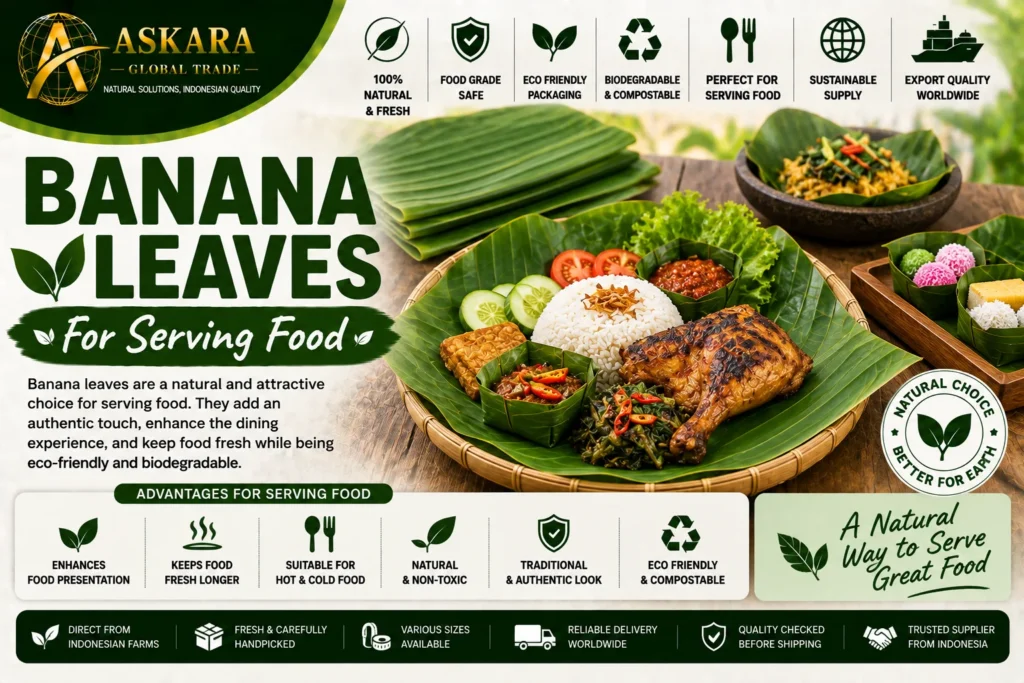
Banana Leaves for Serving Food: Natural Presentation Ideas
Banana leaves have long been used to serve food in many culinary traditions. Their broad surface, natural green appearance, and connection with traditional cuisine make them more than a practical plant material.
A clean banana leaf can become a serving liner, food mat, plate covering, tray liner, or presentation element. As a result, restaurants and food businesses can use it to create a more distinctive dining experience without making the presentation unnecessarily complicated.
From traditional Indonesian meals to South Asian dining and specialty restaurants in international markets, banana leaves continue to offer a recognizable connection between food and nature.
Why Serve Food on Banana Leaves?
Serving food on banana leaves can change the visual character of a meal immediately.
The natural green surface creates contrast with rice, grilled foods, vegetables, seafood, snacks, and colorful sauces. At the same time, the leaf can reinforce the traditional character of certain dishes.
There are also practical advantages.
A properly prepared leaf can:
- Provide a natural serving surface
- Separate food from the table or serving tray
- Create a distinctive presentation
- Support traditional dining styles
- Add visual texture to a meal
- Reduce the need for additional decorative materials
However, banana leaves should be sourced and handled appropriately when they will come into direct contact with food.
What Foods Can Be Served on Banana Leaves?
Banana leaves work particularly well with foods that benefit from a natural or traditional presentation.
Suitable examples include:
- Rice dishes
- Grilled fish
- Grilled chicken
- Seafood
- Satay
- Traditional snacks
- Rice cakes
- Fried foods
- Vegetables
- Tropical desserts
The leaf can be used beneath the food rather than wrapped around it.
This makes it particularly useful when the purpose is presentation rather than cooking.
Banana Leaves as a Serving Liner
One of the simplest approaches is to place a clean section of banana leaf beneath the food.
The leaf can line:
- Plates
- Wooden trays
- Baskets
- Serving boards
- Food boxes
- Catering trays
This technique does not require complicated folding.
Simply cut the leaf to a practical size, clean it properly, and place it on the serving surface before adding the food.
For individual portions, pieces around 20–40 cm can be practical, depending on the plate and the amount of food being served.
Banana Leaves as a Natural Plate Surface
In some traditional dining settings, banana leaves can serve as the primary surface for a meal.
This is especially familiar in South Indian food culture, where meals may be served directly on banana leaves.
Instead of using a conventional plate for every component, rice, vegetables, curries, side dishes, and other foods can be arranged across the leaf.
The result is both practical and visually distinctive.
Restaurants using this approach need to pay particular attention to leaf cleanliness, size, handling, and table preparation.
Banana Leaves for Restaurant Presentation
Restaurants can use banana leaves in different ways depending on their concept.
A casual restaurant may place a leaf beneath grilled food, while a traditional restaurant may use it as the main serving surface.
Meanwhile, a modern restaurant can use a smaller leaf section as a visual accent beneath a plated dish.
The approach does not need to be elaborate.
Often, a simple green leaf beneath a carefully arranged dish is enough to create a recognizable natural presentation.
Banana Leaves for Catering
Catering businesses can also benefit from banana leaves when preparing food for events.
A leaf can line a serving tray or individual food container. It can also help distinguish different dishes within a buffet arrangement.
For outdoor events, traditional celebrations, weddings, and cultural gatherings, banana leaves can complement the overall atmosphere particularly well.
Catering companies should nevertheless consider transportation and handling. The leaves need to arrive in a condition that allows them to be cleaned, prepared, and placed on serving surfaces efficiently.
Banana Leaves for Food Events
Food festivals, cultural events, and specialty dining experiences can use banana leaves to reinforce a particular culinary theme.
For example, a Southeast Asian food event can incorporate banana leaves into the presentation of rice dishes, grilled foods, snacks, and desserts.
The leaf creates an immediate visual connection with tropical and traditional cuisine.
Therefore, it can contribute to the atmosphere of an event without requiring expensive decorative materials.
How to Prepare Banana Leaves for Serving
Serving requires careful preparation because the leaf may have direct contact with ready-to-eat food.
Select Suitable Leaves
Choose fresh, green leaves with a clean and relatively smooth surface.
Avoid leaves with excessive damage or deterioration.
Wash the Leaves
Rinse the leaves with clean water to remove visible dirt and debris.
Handle them carefully so the surface remains intact.
Cut to Size
Cut the leaf according to the serving application.
For many individual servings, 20–40 cm can be a practical range. Larger trays or shared meals may require a different arrangement.
Soften Only When Necessary
If the leaf needs to be folded or shaped, brief exposure to controlled heat can make it more flexible.
For a flat serving liner, softening may not always be necessary.
Allow the Leaf to Cool
If heat has been used during preparation, allow the leaf to cool before placing ready-to-eat food on it.
Should Banana Leaves Be Heated Before Serving?
Not necessarily.
If the leaf is being used as a flat serving liner, cleaning and cutting may be sufficient.
Heating becomes more useful when the leaf needs to be folded or shaped.
Some traditional practices also lightly heat banana leaves because this can make them more flexible and easier to handle.
The preparation method should therefore match the intended use rather than applying the same process to every serving situation.
Choosing the Right Size for Food Presentation
Size affects both appearance and practicality.
A serving piece that is too small may become hidden underneath the food. Conversely, a very large leaf can dominate the plate and make the presentation look less balanced.
For individual portions, 20–40 cm can provide a useful starting range.
Restaurants and caterers can test different dimensions with their actual plates and menu portions.
The goal is to create enough visible leaf area to enhance the presentation without making it look excessive.
Banana Leaves for Traditional Indonesian Food
Indonesia has a strong culinary connection with banana leaves.
They are used not only for cooking and wrapping but also for presenting traditional foods.
Rice dishes, grilled foods, steamed preparations, snacks, and traditional cakes can all be served with banana leaves.
For many Indonesian dishes, the leaf reinforces the traditional character of the meal.
This is particularly useful for restaurants and catering businesses that want their presentation to reflect local culinary traditions.
Banana Leaves for South Asian Food
Banana leaves are also strongly associated with South Indian dining.
In traditional banana-leaf meals, rice and a variety of side dishes can be arranged directly on the leaf.
This serving style demonstrates how a banana leaf can function as more than decoration. It can become an integral part of the dining format.
Restaurants that adopt this style need an efficient system for preparing, transporting, cleaning, and placing the leaves before service.
Banana Leaves for Street Food
Street food businesses can use banana leaves as simple food liners and serving materials.
The approach can work particularly well for rice dishes, snacks, grilled foods, and other foods that are traditionally associated with natural wrapping.
A leaf can also create a recognizable presentation that distinguishes a food stall from businesses using ordinary paper or plastic alone.
However, food safety and local regulations should always guide how leaves are used for ready-to-eat food.
Banana Leaves for Takeaway Food
Banana leaves can also be incorporated into certain takeaway presentations.
For example, a food business may place a suitable leaf section beneath a prepared dish inside an appropriate food container.
The leaf can provide visual appeal while keeping the food presentation connected to traditional cuisine.
However, the leaf should not automatically be treated as a substitute for a leakproof or protective food container.
For foods containing significant amounts of liquid, the primary container still needs to provide adequate protection during transport.
Fresh Banana Leaves for Hotels and Hospitality
Hotels, resorts, and hospitality businesses can use banana leaves to create a tropical or traditional presentation.
They may be suitable for:
- Breakfast presentations
- Specialty dining
- Cultural events
- Poolside food service
- Buffet displays
- Themed dinners
The application depends on the hotel’s concept and food-service standards.
A carefully trimmed leaf beneath a tropical breakfast or traditional dish can create a natural visual identity without requiring elaborate decoration.
Using Banana Leaves in International Food Markets
The international use of banana leaves is closely connected to the growth of Asian, tropical, and specialty food businesses.
Restaurants in Singapore, Kuala Lumpur, and Bangkok commonly operate within food cultures where banana-leaf presentation is already familiar.
In Tokyo, Osaka, Seoul, Busan, and Hong Kong, restaurants serving Asian and specialty cuisines may incorporate banana leaves into selected dishes.
Meanwhile, food businesses in Sydney, Melbourne, Auckland, Dubai, London, Paris, Amsterdam, Toronto, Vancouver, Los Angeles, and New York can use banana leaves to support traditional or Asian-inspired food presentation.
The application does not need to be identical in every market. A restaurant can adapt the leaf to its own cuisine, serving style, and customer expectations.
Fresh vs Frozen Banana Leaves for Serving
Fresh and frozen leaves can both have culinary uses, but their handling characteristics differ.
Fresh leaves can be convenient when the business has regular access to a nearby or reliable supply.
Frozen leaves can be practical when longer storage is important.
After thawing, frozen leaves can become flexible enough for many applications. Nevertheless, businesses should check the condition of each batch before using the leaves for food presentation.
For restaurants that need a consistent visual standard, the condition of the leaves should be evaluated before service.
Food Safety When Serving Food on Banana Leaves
Because serving involves direct contact with ready-to-eat food, sourcing and handling deserve particular attention.
Use banana leaves obtained from a suitable food-use source. Clean them properly before service and keep prepared leaves protected from contamination.
Restaurants and catering businesses should also follow their own food safety procedures and applicable local requirements.
Natural material still requires proper hygiene.
A visually attractive leaf should never be used if its source, handling, or condition is unsuitable for food contact.
Common Mistakes in Banana Leaf Food Presentation
Using Dirty Leaves
Visible dirt or debris can immediately undermine the presentation and create a food safety concern.
Choosing Excessively Damaged Leaves
Large tears can make the serving surface look untidy.
Using the Wrong Size
A leaf that is too large or too small can make the plate look unbalanced.
Treating the Leaf as a Complete Food Container
A serving liner does not necessarily provide protection against leaks or spills.
Ignoring Storage
Poor handling before service can cause leaves to dry out, tear, or lose their visual quality.
Fresh Banana Leaves for Commercial Serving
Restaurants, catering companies, hotels, food-service businesses, and specialty food producers may require a regular supply of fresh banana leaves for presentation.
Commercial buyers often look for:
- Consistent leaf condition
- Practical dimensions
- Reliable quantities
- Suitable packing
- Regular availability
- Flexible ordering
PT Askara Global Trade supplies fresh Klutuk banana leaves from Indonesia for suitable culinary and commercial applications.
The leaves can be supplied in practical sizes around 20–40 cm, depending on buyer requirements and product availability. Orders can be discussed by piece or kilogram.
For businesses introducing banana leaves into their serving process, testing the leaves with the actual plates, trays, food portions, and service workflow is recommended.
How to Create a Simple Banana Leaf Presentation
You do not need elaborate folding techniques.
A simple presentation can follow these steps:
- Select a fresh leaf in good condition.
- Clean the surface properly.
- Cut the leaf to match the serving surface.
- Place it flat beneath the food.
- Arrange the food neatly.
- Add other presentation elements only when they complement the dish.
This approach keeps the natural character of the leaf visible without making the presentation unnecessarily complicated.
Final Thoughts
Banana leaves for serving food offer a simple way to create a natural and distinctive presentation.
They can function as serving liners, plate surfaces, tray coverings, food presentation accents, and traditional serving materials. Their versatility makes them relevant to restaurants, catering companies, hotels, food events, and specialty food businesses.
For individual portions, 20–40 cm can be a practical size range, although the best dimensions depend on the plate, tray, food portion, and desired presentation.
Proper sourcing, cleaning, handling, and storage remain essential, especially when the leaf will directly touch ready-to-eat food.
PT Askara Global Trade supplies fresh Klutuk banana leaves from Indonesia for commercial and international buyers. Businesses can discuss their required quantity, preferred dimensions, intended application, and destination with our team.
