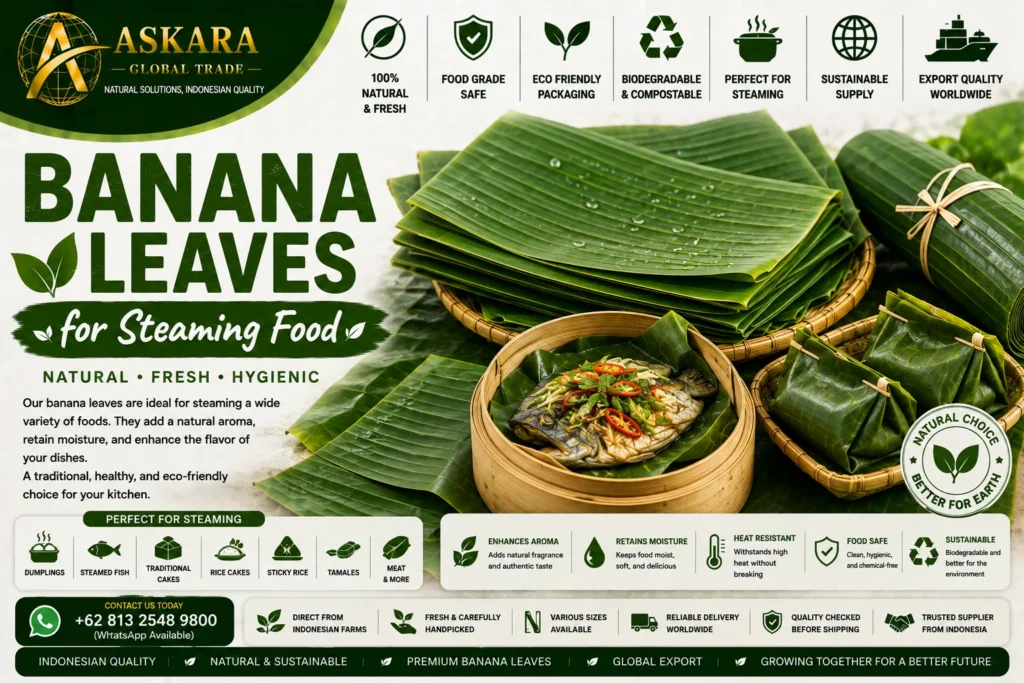
Banana leaves have been used for steaming food in many traditional cuisines for generations. Their broad surface makes them convenient for wrapping ingredients, while their natural flexibility allows them to form a secure package around food.
When heated with steam, banana leaves can help retain moisture and keep ingredients together. They can also contribute a subtle natural aroma and create an attractive presentation when the food is served.
For home cooks and food businesses, using banana leaves for steaming food is relatively simple once the leaves have been properly cleaned, softened, and prepared.

Why Use Banana Leaves for Steaming Food?
Steaming works particularly well with banana leaves because the leaf can surround the food while allowing it to cook in a moist environment.
The wrapper can help:
- Keep ingredients together
- Retain moisture
- Protect delicate food
- Hold sauces and seasonings around the ingredients
- Create a natural presentation
- Add a subtle aroma during cooking
The leaf itself is generally used as a wrapper rather than as something to eat.
This makes it useful for recipes where the food needs to remain moist and contained during steaming.
What Foods Can Be Steamed in Banana Leaves?
Banana leaves can be used with a wide variety of ingredients.
Common examples include:
- Fish
- Seafood
- Chicken
- Seasoned meat
- Vegetables
- Sticky rice
- Rice cakes
- Dumplings
- Traditional snacks
- Coconut-based desserts
Fish is particularly suitable because wrapping it in a banana leaf can help protect the flesh while keeping seasonings, herbs, and other ingredients around the food.
Rice-based foods can also benefit from the wrapper because the leaf helps maintain the shape of the preparation during steaming.
How to Choose Fresh Banana Leaves for Steaming
The condition of the leaf matters when preparing steamed food.
Choose leaves that have:
- A fresh green appearance
- Good flexibility
- A relatively smooth surface
- Minimal tears
- No excessive dryness
- Suitable dimensions for the food
For many commercial food applications, leaves measuring around 20–40 cm can be practical depending on the portion size and wrapping method.
The right size ultimately depends on the food being prepared. Larger portions may require more than one section or a larger wrapping arrangement.
How to Clean Banana Leaves Before Steaming
Banana leaves should be cleaned before they come into contact with food.
Start by rinsing the surface with clean water to remove visible dirt and debris. Handle the leaf gently to avoid creating unnecessary tears.
If the leaves are intended for direct food contact, they should come from a suitable culinary source.
For commercial kitchens, cleaning and handling should also follow the business’s established food safety procedures.
How to Soften Banana Leaves for Steaming
Fresh banana leaves can sometimes crack when folded while they are cold or stiff.
Softening the leaves makes them easier to wrap around food.
One common method is to pass the leaf briefly over controlled heat. The leaf should be moved continuously so that one section does not become excessively hot.
Another option is to expose the leaf to hot water or gentle steam for a short period.
The objective is to make the leaf flexible rather than cook or burn it.
Once the leaf bends easily without cracking, it is ready for wrapping.
How to Wrap Food in Banana Leaves
After cleaning and softening the leaf, place the food near the center.
Avoid putting too much food in one package because excessive filling can place pressure on the folds.
Bring the sides of the leaf toward the center and fold the ends over the food. Depending on the recipe, the package can be secured with suitable food-safe string or another appropriate method.
The wrapping should be secure without being excessively tight.
A little space around the food can make the package easier to close and reduce the risk of tearing.
How Long Should Food Be Steamed in Banana Leaves?
There is no universal steaming time for banana-leaf recipes.
The cooking time depends on several factors, including:
- Type of food
- Portion size
- Thickness of the ingredients
- Amount of food inside the package
- Steamer temperature
- Recipe
- Desired texture
A small fish parcel, for example, may require a different cooking time from a large rice-based preparation.
Therefore, follow the cooking requirements of the specific recipe rather than relying on the banana leaf to determine when the food is ready.
Banana Leaves for Steamed Fish
Steamed fish is one of the applications where banana leaves can be particularly useful.
The fish can be placed on a softened leaf together with herbs, spices, vegetables, or sauces. The leaf is then folded around the ingredients before the package is placed inside the steamer.
The wrapper helps keep the ingredients together while the steam cooks the food.
This technique can also create an appealing presentation when the package is opened just before serving.
Banana Leaves for Steamed Rice
Rice and rice-based foods are also commonly prepared using banana leaves.
The leaf can help contain sticky rice mixtures and traditional rice preparations during steaming.
Depending on the recipe, the leaves can be folded into small parcels or used as a larger lining material.
The correct folding technique depends on the type of rice dish and the desired final shape.
Banana Leaves for Traditional Steamed Foods
Banana leaves have an important role in traditional food preparation across Indonesia and other parts of Asia.
In Indonesia, dishes such as pepes use banana leaves to wrap seasoned ingredients before steaming or cooking.
The leaf is therefore not simply a practical cooking material. It can also contribute to the identity and presentation of the dish.
This connection between the leaf and traditional cuisine is one reason banana-leaf cooking continues to be used even with modern cooking materials readily available.
Using Banana Leaves for Steaming Around the World
Banana-leaf steaming is associated with many food traditions beyond Indonesia.
In Singapore, Kuala Lumpur, and Bangkok, banana leaves are familiar in Southeast Asian and South Indian cuisine. Restaurants and specialty food businesses in Tokyo, Osaka, Seoul, and Hong Kong may also use banana leaves for selected Asian dishes.
Outside Asia, cities such as Sydney, Melbourne, Auckland, Dubai, London, Paris, Amsterdam, Toronto, Vancouver, Los Angeles, and New York have diverse food communities where banana leaves can be relevant to traditional Asian and international cuisine.
The exact use varies from market to market, but the technique remains connected to foods where natural wrapping and traditional presentation are valued.
Can Frozen Banana Leaves Be Used for Steaming?
Frozen banana leaves can be used for many steaming applications.
After thawing, they can become flexible enough for wrapping. However, they should still be handled carefully because excessive folding can cause tears.
Fresh leaves may be preferred when buyers want freshly harvested material, while frozen leaves can be practical when longer storage or availability is a concern.
The best choice depends on the recipe, storage conditions, supply availability, and frequency of use.
Common Mistakes When Steaming with Banana Leaves
Using Dry or Brittle Leaves
Leaves that are too dry may crack when folded.
Skipping the Softening Step
Trying to fold stiff leaves can cause tears along the veins.
Overfilling the Package
Too much food can place excessive pressure on the wrapper.
Making the Package Too Tight
Excessive tension can cause the leaf to split during preparation or cooking.
Using Excessive Heat
Banana leaves can burn when exposed directly to intense heat for too long. When softening them, use controlled heat and keep the leaf moving.
Ignoring Food Safety
Leaves used for direct food contact should be appropriately sourced, cleaned, and handled.
Fresh Banana Leaves for Commercial Steaming
Restaurants, catering companies, food manufacturers, and specialty food businesses may use banana leaves as part of their regular food preparation.
Commercial users often need more consistency than home cooks. They may require specific sizes, larger quantities, suitable packing, and reliable supply.
PT Askara Global Trade supplies fresh Klutuk banana leaves from Indonesia for suitable commercial food applications.
The available leaves can be supplied in practical sizes around 20–40 cm, depending on the product and buyer requirements. Orders can be discussed by piece or kilogram, while specific sizing requirements can be considered for suitable orders.
For businesses planning regular use, testing the leaves with the actual recipe and steaming equipment is recommended before establishing a recurring supply.
How to Store Fresh Banana Leaves Before Steaming
Fresh banana leaves should be handled carefully after purchase or delivery.
Avoid unnecessary folding, crushing, or exposure to conditions that can cause excessive drying.
The appropriate storage method depends on how quickly the leaves will be used, the quantity purchased, and whether the product is being supplied fresh or frozen.
Commercial buyers should establish storage procedures that fit their own food safety system and expected usage period.
Choosing the Right Size for Steaming
The ideal banana leaf size depends on the food portion and wrapping method.
Leaves around 20–40 cm can be suitable for many individual portions, but the actual requirement depends on how much food needs to be enclosed.
Before ordering in large quantities, businesses can test different sizes with their recipes.
This can help determine whether the leaf provides enough coverage without creating unnecessary waste.
Fresh Banana Leaves for Food Businesses
For restaurants and food producers, banana leaves can provide both practical and visual value.
They can be used for traditional steamed dishes, specialty menus, food presentation, and selected food preparation processes.
A consistent supply can make it easier for kitchen teams to maintain the same preparation method from one order to the next.
PT Askara Global Trade works with commercial and international buyers looking for fresh banana leaves from Indonesia.
Buyers can discuss their intended application, required quantity, preferred size, and destination before arranging supply.
Final Thoughts
Banana leaves for steaming food offer a natural way to wrap ingredients while they cook in a moist environment.
The best results come from choosing fresh leaves, cleaning them properly, softening them before folding, and selecting a size that suits the food.
For many applications, leaves around 20–40 cm can provide a practical starting point, although the ideal size depends on the recipe and portion.
From traditional Indonesian dishes to Asian food businesses in international markets, banana leaves continue to provide a useful combination of cooking function and natural presentation.
If your business needs fresh banana leaves from Indonesia for steaming or other suitable food applications, PT Askara Global Trade can discuss your required quantity, size, application, and destination.